Homeowners across Davis County, from Layton to Bountiful, ask Utah Pavilion Company the same question before they commit to a backyard gazebo: what’s the best wood for a gazebo that will actually hold up through a Utah winter? The answer shapes everything else, from the finish schedule to how the joinery holds after ten Utah snow seasons. Cedar, redwood, and pressure-treated pine all show up in gazebo kits and custom builds, but they age very differently once real weather hits them. We design and build custom timber gazebos across Utah, and we hear this question on nearly every consultation call.
Quick Answer: Cedar is the best wood for a gazebo for most Utah homeowners because its natural oils resist rot, decay, and insects without chemical treatment, and it remains stable through Utah’s changing seasons. Redwood offers similar durability but typically costs more in this region, while pressure-treated pine is the most budget-friendly option but requires more maintenance. At Utah Pavilion Company, we build our handcrafted gazebos in Western Red Cedar or Douglas Fir to provide lasting strength and performance.
Key Takeaways
- Cedar’s natural oils resist rot, decay, and insects without any chemical treatment.
- Redwood offers similar durability to cedar but typically costs more once it ships to Utah.
- Pressure-treated pine costs less upfront but needs more frequent sealing and can warp.
- We build every gazebo frame in Western Red Cedar or Douglas Fir, joined with mortise-and-tenon joinery and no metal brackets.
- Utah’s dry air, intense sun, and winter snow load all affect which wood and finish schedule make sense.
Best Woods for a Gazebo, Compared
Cedar, redwood, and pressure-treated pine are the three woods most gazebo buyers compare, and each one trades upfront cost against long-term durability differently. Cedar and redwood both carry natural oils and extractives that resist decay without any chemical treatment. Pressure-treated pine relies on that treatment instead, which lowers the price but adds its own maintenance schedule. None of the three is maintenance-free, so the real differences come down to how much upkeep each one needs and how it ages.
One clarification before the comparison: the wood-versus-wood notes below reflect what’s available across the broader gazebo market, including pre-cut kits. Utah Pavilion Company builds gazebos as fully custom, handcrafted structures rather than DIY kits, so every frame we deliver is site-built in Western Red Cedar or Douglas Fir, not boxed and shipped.
The table below compares the three on the factors that matter most for an outdoor structure that sits in Utah weather year-round.
Cedar vs. Redwood vs. Pressure-Treated Pine for Gazebos
| Wood | Natural Decay Resistance | Typical Appearance | Maintenance Needs | Best Fit |
| Western Red Cedar | High, no chemical treatment | Warm reddish-brown, fine straight grain | Stain or seal every 1 to 2 years | Custom timber gazebos and pavilions |
| Redwood | High, no chemical treatment | Rich reddish tone, straight grain | Stain or seal every 1 to 2 years | Premium builds where redwood is priced well |
| Pressure-Treated Pine | Moderate, chemically treated | Pale green tint that fades to gray | Sealing every year, more prone to warping | Budget kits and non-structural trim |
Cedar and Douglas Fir are the woods we frame gazebos in ourselves, so the redwood and pressure-treated pine notes above come from general wood-industry research rather than our own build stock. If you’re weighing a redwood or pine kit against a custom Utah Pavilion Company gazebo, the table above is an honest starting point for that comparison.
Why Cedar Is the Top Choice for a Timber Gazebo
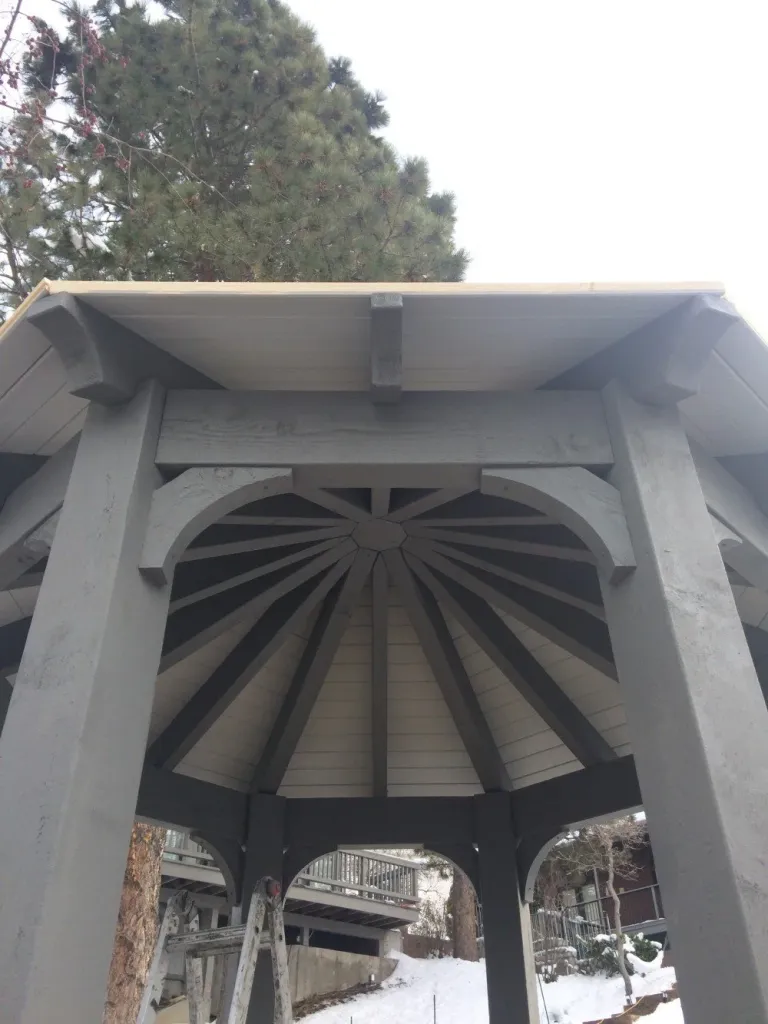
Cedar tops the list because its natural oils fight rot, decay, and insect damage without any chemical treatment at all. Western Red Cedar heartwood contains extractives that make it inhospitable to the fungi that cause wood decay, and that same chemistry keeps most insects from treating it as a food source. Cedar also moves less than many softwoods as humidity swings through the seasons, so mortise-and-tenon joints stay tight for longer. It takes a stain evenly and holds its color instead of yellowing the way some construction-grade pine does.
Weight matters too. Cedar’s oven-dry density runs about 21 pounds per cubic foot, compared to roughly 31 pounds per cubic foot for Douglas Fir, so a cedar frame is noticeably lighter to handle on site without giving up strength where it counts.
Natural Oils, Stability, and Appearance
Independent research from the Western Red Cedar Lumber Association points to cedar’s decay and insect resistance as its defining structural advantage, along with the dimensional stability it holds once it’s dried and finished. That stability is why cedar corner posts and rafter tails stay square instead of cupping the way some construction lumber can.
That resistance applies most directly above ground. The same research notes that wood kept in prolonged contact with the ground, such as a post set directly into soil, should still get a preservative treatment even when it’s cedar. That’s part of why we set gazebo posts on concrete piers or footings instead of burying the wood directly, keeping the naturally resistant heartwood doing the job it’s actually good at.
Appearance is part of the case too. Cedar’s tight, straight grain takes both solid-color stains and clear or semi-transparent finishes well, so it fits a rustic cabin look or a cleaner modern gazebo with equal ease.
When Redwood or Pressure-Treated Pine Make Sense
Redwood or pressure-treated pine make sense when regional availability or a tight upfront budget outweighs long-term upkeep. Redwood grows on the West Coast, so it can cost less than cedar in markets close to its source and more once it ships inland to Utah. Long-term durability research from the USDA Forest Products Laboratory places redwood heartwood and Douglas Fir heartwood in the same top decay-resistance tier as cedar, so redwood is a legitimate structural choice where it’s priced competitively.
Pressure-treated pine is the budget option. The chemical treatment protects it from rot and insects for a period, but it needs more frequent sealing, and it’s more likely to warp, split, or check as it dries out in Utah’s low humidity.
Premium Look vs. Budget Durability
A redwood gazebo photographs beautifully and holds up well once it’s properly sealed, which makes it a fair trade for buyers who want a premium look and can source it locally at a reasonable price. A pressure-treated pine kit is the right call for a starter structure on a strict budget, as long as the buyer plans to reseal it every year and accepts a shorter service life than cedar, redwood, or Douglas Fir.
We don’t stock pressure-treated pine or redwood ourselves. We build in Western Red Cedar or Douglas Fir because both hold up to Utah’s freeze-thaw cycle without a chemical treatment, and both take mortise-and-tenon joinery cleanly, which a pressure-treated frame can complicate over time as the wood shrinks around metal fasteners.
Wood vs. Metal and Vinyl Gazebos
Wood outperforms metal and vinyl gazebos on visual appeal, long-term durability, and design flexibility, though metal and vinyl both cost less to buy up front. Metal-framed gazebos resist rot, but the protective coating eventually wears through and lets rust set in at the welds. Vinyl gazebos need no staining, but the material cracks in cold weather and cannot be resized or refinished later.
| Feature | Timber | Metal | Vinyl |
| Visual appeal | Natural warmth, timeless charm | Cold, industrial | Cold, industrial |
| Strength & longevity | Durable, ages beautifully | Strong but rusts over time | Cracks and wears |
| Design flexibility | Fully custom size, stain, joinery | Limited shapes and finishes | Minimal variation |
| Eco-conscious | Sustainably sourced wood | Often non-renewable or imported | Synthetic, less eco-friendly |
Timber is the only one of the three that can be fully custom in size, stain, and joinery, and it’s the only one that tends to age into a better-looking structure instead of a worse one.
Choosing Gazebo Wood for Utah’s Climate
Utah’s dry air, intense high-elevation sun, and heavy mountain snow load all push gazebo wood harder than a milder coastal climate does. UV exposure at elevation bleaches an unfinished or unsealed wood surface faster than most buyers expect, which is part of why we recommend a fresh stain or sealer every one to two years regardless of species.
Low humidity also means wood dries out and moves more than it would in a wetter climate, so a stable species like cedar or Douglas Fir holds its joinery tighter through the swing between a dry August and a wet spring.
Sun, Snow Load, and Seasonal Swings
Snow load is a structural question, not a wood-species question, and it deserves an engineer’s input rather than a DIY estimate. The right approach is to ask your builder for the ground snow load rated for your specific city, the roof pitch, the footing type, and whether your jurisdiction requires a permit before you commit to a size or design.
We route those specifics to a site visit and a free quote rather than publishing a single number here, because snow load varies by elevation even within Davis County. What we can say is that Cedar and Douglas Fir both perform well as structural framing once a design accounts for your actual site conditions, and our mortise-and-tenon joinery is built to hold under that load without relying on metal brackets that can loosen or rust over time.
Freeze-thaw cycling affects the foundation as much as the frame. A gazebo set on a base that heaves with the frost line will rack the wood joinery above it no matter how good the wood is, so foundation choice and wood choice are really the same conversation.
Insect Pressure in a Utah Backyard
Utah backyards see fewer termite problems than a humid climate does, but carpenter ants still target softwoods that hold moisture against the ground or in a shaded, damp corner. Cedar’s natural extractives make it a poor food source for both, which is one more reason it holds up better than untreated pine in a shaded gazebo footprint near sprinklers or mulch beds.
Keeping the base of any post off wet soil, whether with a concrete footing or a raised paver base, matters as much as the wood species for keeping insects and moisture away from end grain, which is the most vulnerable part of any timber frame.
How to Spot Quality Cedar Before You Buy

Not all cedar sold for outdoor structures is the same grade, and the grade matters as much as the species. Heartwood, the darker inner wood of the tree, resists decay far better than the pale sapwood cut from nearer the bark. A quality cedar gazebo frame uses heartwood or a heartwood-heavy grade for any piece that will see direct weather exposure.
Clear or select-grade cedar, with few or no knots, holds a finish more evenly and is less likely to develop a crack at a knot over time. Knotty grades aren’t a defect on their own, but a knot near a joint is a weak point worth avoiding in a load-bearing post or beam. Look for a grade stamp when you’re buying cedar lumber directly.
Kiln-Dried vs. Green Cedar for Framing
Kiln-dried cedar has already done most of its shrinking before it’s cut and joined, so a frame built from kiln-dried stock holds its mortise-and-tenon joints tighter than one built from green, unseasoned wood that’s still drying and moving after installation. Ask any gazebo builder or kit supplier whether the framing stock is kiln-dried before you buy, cedar included.
The grade also determines how well a post or beam takes a hand-cut mortise-and-tenon joint. A tight, straight-grained piece cuts cleanly and glues or pins without splitting along a hidden knot line, while a lower grade with more knots and grain runout is more likely to crack right where the joint needs to be strongest.
How We Build Timber Gazebos in Douglas Fir and Cedar
We build every gazebo frame in Western Red Cedar or Douglas Fir, joined with mortise-and-tenon joinery and no metal brackets. That’s a deliberate choice, not a default. Wood-to-wood joints move with the frame through Utah’s seasonal swings instead of loosening the way a bolted metal bracket connection can over ten or twenty years.
We also design and build the gazebo ourselves rather than only shipping a kit. We don’t just ship kits; we build what we sell, and that shows up in details like clean, tidy job sites and a transparent pricing process that walks you through what drives your specific quote before you commit to a size or wood species.
One recent customer told us the process felt smooth and stress-free from design through installation, which is the experience we aim for on every build. If a fully enclosed gazebo isn’t quite the right fit for your yard, our pergolas use the same Douglas Fir or Cedar framing and mortise-and-tenon joinery, in either an open lattice-top style or a Solid Roof Pergola for full weather protection.

Frequently Asked Questions About Gazebo Wood
Is cedar or redwood better for a gazebo?
Cedar and redwood perform similarly on decay resistance, so we generally recommend cedar for Utah builds. It is easier to source locally, and it holds a stain evenly through our freeze-thaw seasons, while shipped-in redwood can cost more once freight is added.
Can you use pressure-treated pine for a gazebo?
Pressure-treated pine can frame a gazebo, but Utah Pavilion Company does not build with it. We use Douglas Fir or Cedar with mortise-and-tenon joinery instead, because treated pine needs more frequent resealing and is more prone to warping as it dries.
Does gazebo wood need to be sealed or stained every year?
Most gazebo wood benefits from a fresh stain or sealer every one to two years in Utah’s sun and dry air. Utah Pavilion Company can walk you through a finish schedule for cedar or Douglas Fir as part of your free quote consultation.
How long does a cedar gazebo last?
A well-built, well-maintained cedar gazebo can last well beyond two decades. Utah Pavilion Company frames each gazebo with mortise-and-tenon joinery instead of metal brackets, which keeps the connections tight as the wood moves with the seasons. See our gazebo lifespan guide for a full material-by-material breakdown.
Do you build gazebos in Douglas Fir too?
Yes. Utah Pavilion Company builds custom timber gazebos in Western Red Cedar or Douglas Fir, and both are premium framing woods, never treated pine.
How is a gazebo different from a pergola or pavilion if the wood is the same?
The wood species is often the same, but the structure is different. Utah Pavilion Company frames gazebos, pergolas, and pavilions all in Douglas Fir or Cedar, and our gazebo vs. pergola vs. pavilion comparison breaks down the roof and shape differences in detail.
Does wood species change the overall cost of a gazebo?
Yes. Wood species is one of the biggest cost drivers in any gazebo build, alongside size, roof style, and site prep. Cedar and Douglas Fir cost more upfront than pressure-treated pine but need less frequent upkeep over the life of the structure. See our gazebo cost guide for a full breakdown of what drives the final number, or reach out for a free quote based on your specific wood choice and design.
Get the Best Wood for a Gazebo, Built by Utah Pavilion Company
Cedar is the best wood for a gazebo in nearly every Utah backyard, with Douglas Fir as our other trusted framing option and redwood or pressure-treated pine as the trade-offs to weigh against them. We build every gazebo with mortise-and-tenon joinery, never metal brackets, and we handle design, delivery, and installation ourselves instead of only shipping a kit. Browse our gazebo gallery to see how Western Red Cedar and Douglas Fir perform in real backyard installations, or contact us for a free, no-obligation quote tailored to your property, preferred wood species, and design goals.