The Core Difference Utah Homeowners Need to Know about Open vs Solid Roof Pergola
Choosing between an open vs. solid roof pergola comes down to one central question: how much protection does your backyard actually need? Utah’s climate gives that question real stakes. Northern communities like Layton, Kaysville, and Farmington face heavy winter snow loads. Summer UV in Utah consistently ranks among the highest in the continental U.S., with the state regularly exceeding a UV Index of 10 or higher on clear days, according to the EPA’s UV Index Scale. Choosing the wrong roof style does not just affect aesthetics. It determines how many days per year you can actually use your space.
This guide breaks down both options across five practical factors: weather protection, year-round usability, natural light, cost, and permit considerations. By the end, you will know exactly which structure fits your backyard and your lifestyle.
What’s the Difference? A Quick Primer on Pergola Roof Types
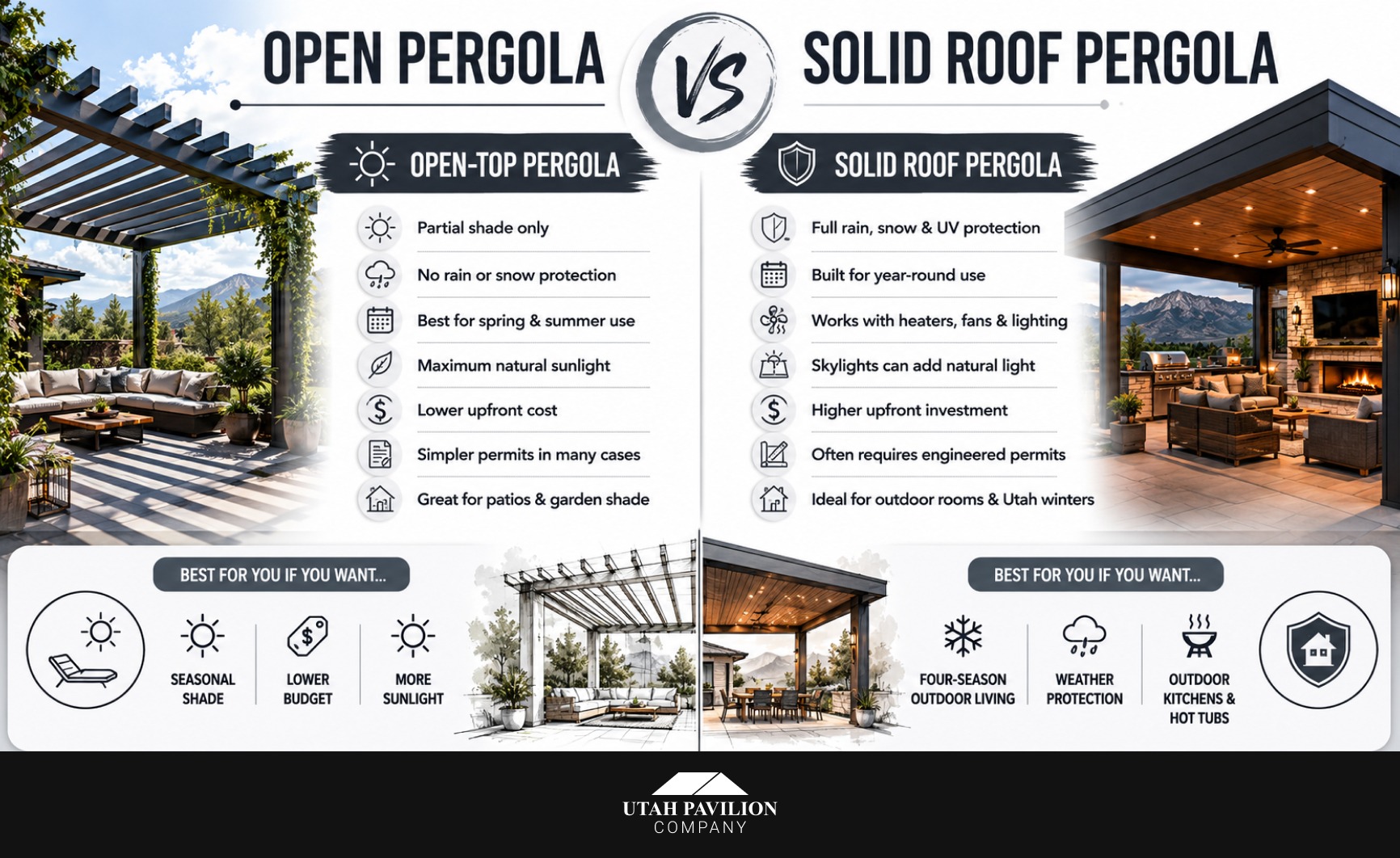
An open-top pergola and a solid roof pergola are built on the same foundation of vertical posts and horizontal beams, but everything above that frame is different.
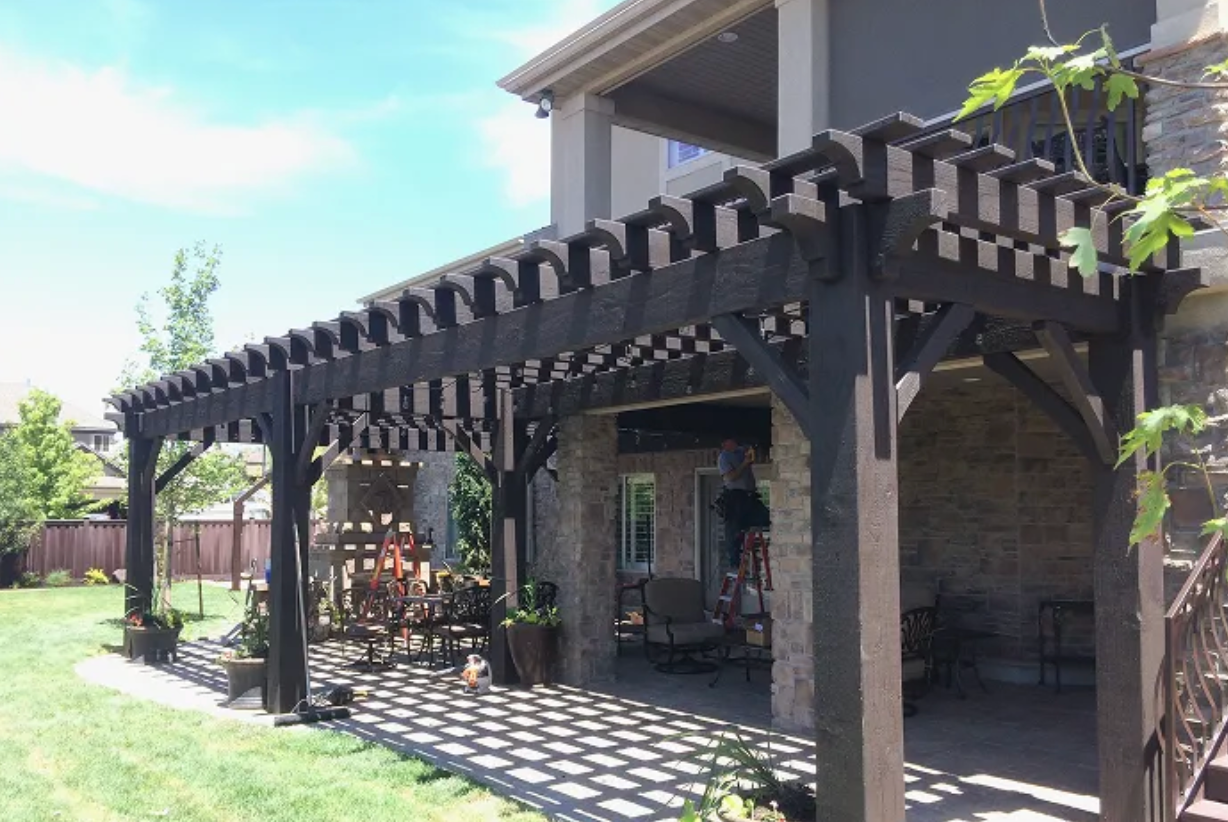
An open-top pergola uses spaced rafters or crossbeams to create filtered shade. Light passes through the gaps, producing the classic dappled shadow pattern many homeowners love. However, an open-top pergola offers no rain protection and allows snow to fall directly through.
A solid roof pergola replaces the open rafter system with a fully enclosed overhead surface. Utah Pavilion Company builds these using quality timber framing topped with solid roofing materials. Both types are available as timber frame structures with mortise and tenon joinery. The defining difference is what happens above your head when weather rolls in.
• Open-top pergola: Classic aesthetic, filtered light, seasonal use, natural airflow
• Solid roof pergola: Full weather protection, year-round usability, can include skylights or translucent panels for added brightness
• Both: Available as timber frame, customizable in size, stain, and style
| Key Takeaway: Neither roof type is universally better. The right choice depends on how you plan to use the space and what Utah’s weather will throw at it across all four seasons. |
Factor 1 – Weather Protection: Where Solid Roofs Pull Ahead
A solid roof pergola provides complete overhead protection from rain, snow, and UV exposure. An open-top pergola provides partial shade on sunny days and very little else when weather shifts.
Utah’s northern Wasatch Front communities, including Farmington, Kaysville, and Layton, receive significant snowfall each season according to the National Weather Service Salt Lake City. An open-top pergola allows all of that snow to pass directly through and accumulate on your patio furniture, grills, and flooring. A solid roof, engineered to handle the load, keeps everything underneath dry and protected.
Summer UV is equally demanding. Utah sits at high elevation, which means UV radiation arrives with less atmospheric filtering. An open pergola’s rafter gaps still allow direct sunlight through in patterns that fade furniture finishes and make prolonged outdoor sitting uncomfortable during peak afternoon hours. A solid roof eliminates direct UV exposure entirely.
| Pro Tip: If your pergola will cover an outdoor kitchen, hot tub, or quality furniture set, a solid roof is the practical choice. Leaving those items exposed to Utah’s snow and intense UV shortens their lifespan and increases your annual maintenance costs significantly. |
Factor 2 – Year-Round Usability: The Case for Solid Coverage
A solid roof pergola extends your usable outdoor season to all 12 months. An open-top pergola, by contrast, typically limits comfortable use to spring, summer, and parts of fall.
Consider how this plays out day to day. With an open top, a spring rainstorm sends guests inside immediately. A July afternoon with a UV Index above 10 makes midday use uncomfortable without supplemental shade structures. October evenings in northern Utah drop into the low 40s, and without any overhead cover, the chill sets in quickly.
A solid roof changes that equation. Combined with an outdoor heater mounted to the structure’s framework, the space stays comfortable well into late fall and on mild winter days. Ceiling fans integrated into solid roof designs move air efficiently during the hottest summer afternoons. The result is a space you actually use consistently, not one you walk past for four or five months of the year.
For Utah homeowners in Layton, Kaysville, Farmington, and surrounding communities, a solid roof can effectively double or triple the number of days the structure gets real use.
| Key Takeaway: Year-round use is where a solid roof justifies its higher upfront cost. If your goal is a functional outdoor room and not just a seasonal accent piece, the long-term value math strongly favors solid coverage. |
Factor 3 – Aesthetic and Natural Light: Where Open Tops Still Win
An open-top pergola creates a visual and atmospheric experience that a solid roof cannot fully replicate. The interplay of light and shadow through spaced timber rafters connects the structure to the surrounding landscape. The feeling is genuinely open and airy. This aesthetic advantage matters most when the pergola serves as a garden focal point or a decorative frame for a patio rather than a fully functional covered room.
That said, solid roof designs have closed the gap considerably. Skylights cut directly into the roof plane bring natural light into the space below. Translucent or polycarbonate panels can replace opaque sections to maintain brightness while still shedding rain. A well-designed solid roof pergola does not need to feel dim or enclosed.
Furthermore, the exposed timber beams and handcrafted mortise and tenon joinery that Utah Pavilion Company builds into every structure remain fully visible from underneath regardless of roof type. Much of the visual warmth and craftsmanship carry through in both designs.
Factor 4 – Cost Comparison: Framing the Investment Correctly
A solid roof pergola costs more than an open-top structure of equivalent size. The additional materials, including roofing panels, sheathing, and snow load engineering, add to both material and labor costs. Contact Utah Pavilion Company directly for a custom quote based on your specific dimensions and site conditions.
However, comparing sticker prices alone misses the real calculation. Think instead about cost per year of use.
An open-top pergola used comfortably for six months costs effectively twice as much per usable month compared to the same dollar figure spread across 12 months with a solid roof. Additionally, uncovered furniture, appliances, and outdoor installations degrade faster under Utah’s UV intensity and seasonal snow exposure. Those replacement and maintenance costs accumulate quietly over several years.
A solid roof also tends to add more measurable resale value. Covered outdoor structures consistently attract more buyer interest because they function as usable living space rather than decorative accent pieces.
| Pro Tip: When comparing quotes, ask for the cost broken down per square foot and per month of expected usable season. That side-by-side view reveals the true value difference between roof types more clearly than total project price alone. |
Factor 5 – Permit and HOA Considerations in Utah
Solid roof pergolas frequently trigger different and more demanding permit requirements than open-top structures in Utah. Understanding this before you build saves time, money, and potential fines. For a full breakdown of what these terms mean in practice, see Utah building permit terms demystified.
Under Utah’s statewide building code, a solid roof may reclassify your structure from a pergola to a patio cover or accessory structure. That reclassification often requires engineered drawings, snow load calculations, and a formal building permit application. Open-top pergolas, depending on size and location, sometimes fall below the permit threshold in Utah municipalities. Always verify with your local building department before assuming any exemption applies.
HOA approval is a completely separate process from city or county permits, and both may be required on the same project. Utah’s 2025 HOA legislation now requires associations to provide specific written reasons when denying an architectural plan, which adds some procedural protection for homeowners. However, HOAs can still restrict structures that do not conform to a community’s governing documents.
For communities across northern Utah, including Farmington, Kaysville, Layton, and Clearfield, snow load engineering is a standard expectation for any solid roof structure. A timber frame solid roof pergola built to handle those loads must be designed with that specification from the start, not added on after the fact.
Working with a builder who understands local code requirements and can provide the documentation needed for permit applications is a real practical advantage for Utah homeowners.
Open Pergola vs. Solid Roof Pergola: Side-by-Side Comparison
| Criteria | Open-Top Pergola | Solid Roof Pergola |
| Weather Protection | Partial shade only. No rain or snow protection | Full overhead protection from rain, snow, and UV |
| Year-Round Use | Spring through early fall (approx. 6 to 7 months) | All 12 months. Pair with heater or fan for comfort |
| Natural Light | Maximum. Dappled, shifting sunlight all day | Reduced, but skylights or translucent panels restore brightness |
| Cost Level | Lower upfront investment | Higher upfront. Stronger value over total years of use |
| Permit Complexity | Often simpler; may fall below threshold | Frequently needs engineered drawings and a formal permit |
| Best For | Garden aesthetics, seasonal shade, lower budgets | Year-round outdoor rooms, hot tubs, kitchens, Utah winters |
Why Utah Homeowners Choose Utah Pavilion Company for Their Pergola
Utah Pavilion Company builds handcrafted timber frame pergolas across northern Utah, including Layton, Kaysville, Farmington, Clearfield, Bountiful, and surrounding communities. Every structure, whether open-top or solid roof, is built using traditional mortise and tenon joinery rather than metal brackets. That approach produces cleaner connections, longer structural life, and a finished look that holds up through Utah’s full range of weather. Explore all pergola styles.
The timber selection matters too. Utah Pavilion Company builds exclusively with premium Douglas Fir or Cedar, not treated pine. Both species are chosen for their natural resistance to decay and their dimensional stability through the temperature swings Utah sees between seasons.
Whether you want the classic appeal of an open-top design or the full-weather functionality of a solid roof pergola, the team designs around your specific site, dimensions, and local permit requirements. Engineered drawings and documentation for permit applications are part of the process, not an afterthought.
For homeowners who want to explore both options side by side with a builder who knows Utah’s code environment, a custom quote is the clearest place to start.

Frequently Asked Questions About Open vs. Solid Roof Pergola
Does a solid roof pergola require a permit in Utah?
Usually yes. A solid roof often reclassifies the structure as a patio cover under Utah code, which typically triggers a formal permit requiring engineered drawings and snow load calculations. Always verify with your local building department before starting construction.
Can I add a solid roof to an existing open-top pergola?
Sometimes, but the original frame may not be engineered for the added weight. A structural assessment is recommended before adding solid roofing to any existing pergola, particularly in Utah where snow load requirements must be factored in from the start.
Does a solid roof pergola get too hot in Utah summers?
Not with proper design. A vented solid roof combined with a ceiling fan moves air effectively and eliminates direct UV overhead. In practice, a well-designed solid roof pergola is often cooler than an open-top on intense Utah summer afternoons because direct sun exposure is removed entirely.
Which pergola type adds more home value in Utah?
Solid roof pergolas generally add more measurable resale value because buyers view them as functional outdoor rooms rather than decorative structures. Covered outdoor spaces consistently attract stronger interest from buyers in Utah’s residential market.
What wood species work best for a pergola in Utah’s climate?
Douglas Fir and Cedar are the strongest choices for Utah’s weather cycles. Both offer natural resistance to decay and dimensional stability through the freeze-thaw cycling common in northern Utah. Utah Pavilion Company builds exclusively with these species and does not use treated pine.
Open vs. Solid Roof Pergola: Which One Should You Build?
Choosing between an open vs. solid roof pergola ultimately depends on how you want to use the space and what Utah’s climate demands from the structure across all four seasons. Open-top pergolas deliver a beautiful natural aesthetic and a lower initial price point. They work well for homeowners who primarily use their outdoor space during mild weather months and want a garden-style feature more than a functional room.
Solid roof pergolas deliver full weather protection, genuine year-round usability, and a stronger long-term return on investment. For northern Utah communities where snow loads and intense UV are facts of life in every season, the solid roof is the clear functional upgrade.
Explore your specific options on the solid roof pergola page or browse all pergola styles to see what fits your backyard. When you are ready to get specific numbers and design guidance, get a free quote from Utah Pavilion Company.