How Long Does a Timber Frame Pavilion Last? Key Factors
Quick Answer A well-built timber frame pavilion can last 25–50+ years when the right wood species, joinery method, and maintenance routine come together. Several variables determine exactly where your structure lands on that range:
- Wood species: Douglas Fir or Cedar versus treated pine
- Joinery type: mortise-and-tenon versus metal brackets
- Local climate: UV intensity, freeze-thaw cycles, snow load
- Maintenance cadence: sealing, staining, and annual inspection
A timber frame pavilion lasts far longer than most homeowners expect, provided it was built correctly from the start. The difference between a structure that stands proud for half a century and one that shows signs of rot within a decade almost always comes down to decisions made before the first post was ever set.
This guide walks through each factor in detail so you understand exactly what affects lifespan and what you can control as an owner.
Wood Species: The Single Biggest Lifespan Variable
The wood species used in your pavilion determines its baseline resistance to moisture, insects, and decay — before any treatment or maintenance is applied. Not all outdoor-grade lumber performs equally when exposed to Utah’s temperature swings and UV radiation year after year.
Douglas Fir vs. Cedar Longevity
At Utah Pavilion Company, every structure is built using either select Douglas Fir or Western Red Cedar. Both are premium choices, and each offers a distinct performance profile.
| Characteristic | Douglas Fir | Western Red Cedar |
|---|---|---|
| Natural rot resistance | Moderate (Class 3) | High (Class 2) Edge |
| Structural strength | Highest of western softwoods Edge | Lower compressive strength |
| Dimensional stability | Excellent — resists warping | Very good |
| Expected lifespan (with care) | 25–35+ years | 30–50+ years |
| Maintenance requirement | Regular sealing essential | Lower — natural oils provide baseline protection |
| Relative cost | More affordable | 10–25% premium |
Cedar contains natural thujaplicins, organic compounds that actively resist fungal decay and insects without any chemical treatment. Douglas Fir compensates with superior density and load-bearing capacity, making it the preferred choice for large-span structural beams. Furthermore, Douglas Fir holds mortise-and-tenon joints exceptionally tightly due to its dimensional stability, which matters enormously for long-term structural integrity.
Neither species is treated as pine. Treated pine requires chemical preservatives to function outdoors, introduces potential long-term leaching concerns, and is widely considered a lower-tier choice for timber frame construction.
Pro Tip: If your pavilion will sit in a shaded, moisture-prone area of your yard — near a fence line, under a canopy of trees, or in a low-drainage corner — Cedar’s built-in rot resistance makes it the smarter long-term investment. For large open designs with wide beam spans, Douglas Fir’s superior strength is the deciding factor.
Why Mortise-and-Tenon Joinery Outlasts Metal Brackets
Joinery is the structural spine of a timber frame pavilion. It is also one of the most overlooked factors when comparing long-term durability across different builders and kit products.
Metal bracket systems connect beams by fastening hardware to wood surfaces. Over time, those connections become a liability. Metals expand and contract at different rates than wood. Utah’s dramatic freeze-thaw cycles — where temperatures swing 30 to 40 degrees in a single day — stress those metal-wood connections repeatedly, year after year.
Consequently, metal brackets can loosen, corrode, and pull away from the surrounding wood, creating gaps that trap moisture and invite decay. The wood around a metal fastener is also mechanically compromised, as drilling creates entry points for water infiltration.
How Mortise-and-Tenon Differs
Traditional mortise-and-tenon joinery cuts a projecting tenon on one timber and a matching mortise pocket on another. The two pieces lock together wood-to-wood. As the structure settles and the wood naturally dries, the joint actually tightens over time.
There are no metal fasteners creating thermal expansion stress, no drilled holes admitting moisture, and no corrosion risk. Similarly, the large surface area of wood-on-wood contact distributes load more evenly across the joint than any bracket system can replicate. This is precisely why timber frame structures built with proper mortise-and-tenon joinery have stood for generations in climates far harsher than Utah’s.
Pro Tip: When evaluating any timber frame pavilion builder or kit supplier, ask specifically whether they use mortise-and-tenon joinery or metal connection hardware. The answer immediately tells you whether the structure is designed to last 15 years or 50.
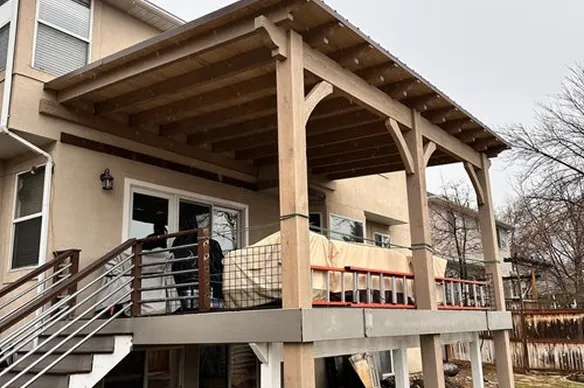
A custom timber frame pavilion built by Utah Pavilion Company using traditional mortise-and-tenon joinery — no metal brackets.
How Utah’s Climate Affects Timber Frame Pavilion Lifespan
Utah is not a forgiving climate for outdoor structures. The Wasatch Front specifically combines intense UV exposure, significant annual snowfall, dramatic freeze-thaw cycles, and low humidity — a combination that accelerates wear on almost every material category.
Understanding these forces helps you maintain your pavilion proactively rather than reactively.
UV Radiation and Lignin Degradation
At Utah’s elevation, UV intensity is significantly higher than at sea level. UV radiation breaks down the lignin in wood — the organic compound that binds wood fibers together and gives timber its structural rigidity. Without a UV-blocking finish, exposed wood begins to gray and degrade within a single season. Additionally, this degradation opens the wood surface to moisture infiltration, compounding the damage.
Freeze-Thaw Cycles
Salt Lake City receives approximately 56 inches of snow annually, and the Wasatch Front experiences repeated temperature swings that take daytime conditions above freezing while nights drop well below. Each freeze-thaw cycle causes materials to expand and contract, stressing wood fibers and any connections where dissimilar materials meet. Mortise-and-tenon joinery handles this movement far better than metal-bracket systems because the joint moves as a single wood-on-wood unit rather than as two materials with different expansion coefficients.
Snow Load
Heavy wet snow can weigh 15 to 20 pounds per cubic foot. A pavilion roof that has not been engineered for Utah’s snow load conditions faces structural stress that can shorten its lifespan substantially — or cause catastrophic failure. This is why roof pitch, beam sizing, and post dimensions all need to be calculated for the specific site, not defaulted to a generic kit specification.
Signs a Pavilion Needs Replacing vs. Repairing
Not every problem means a full replacement. Knowing how to read your structure helps you take targeted action rather than facing an avoidable rebuild.
Signs That Call for Repair
- Surface checking: Hairline cracks running with the grain are normal and purely cosmetic. Sand lightly and re-seal.
- Color graying: UV-related silvering is surface-level. A proper cleaning and re-staining process restores the wood without structural work.
- Loose roofing material: Replace individual shingles or panels as they lift or crack. The timber frame itself is unaffected.
- Minor mold or mildew: A wood cleaner treatment followed by re-sealing addresses surface biological growth before it penetrates.
Signs That May Indicate Replacement
- Soft, spongy wood at post bases: This indicates active rot penetrating beyond the surface. If probing with an awl sinks more than half an inch without resistance, structural integrity is compromised.
- Significant beam deflection: Visible sagging at mid-span suggests overstressing or internal decay. A professional assessment is needed immediately.
- Widespread insect damage: Bore holes throughout multiple timbers, combined with frass deposits, indicate infestation that has progressed past surface treatment.
- Joinery failure: If bracket-based connections have pulled apart or mortise-and-tenon joints have opened significantly, the structural assembly needs professional evaluation.
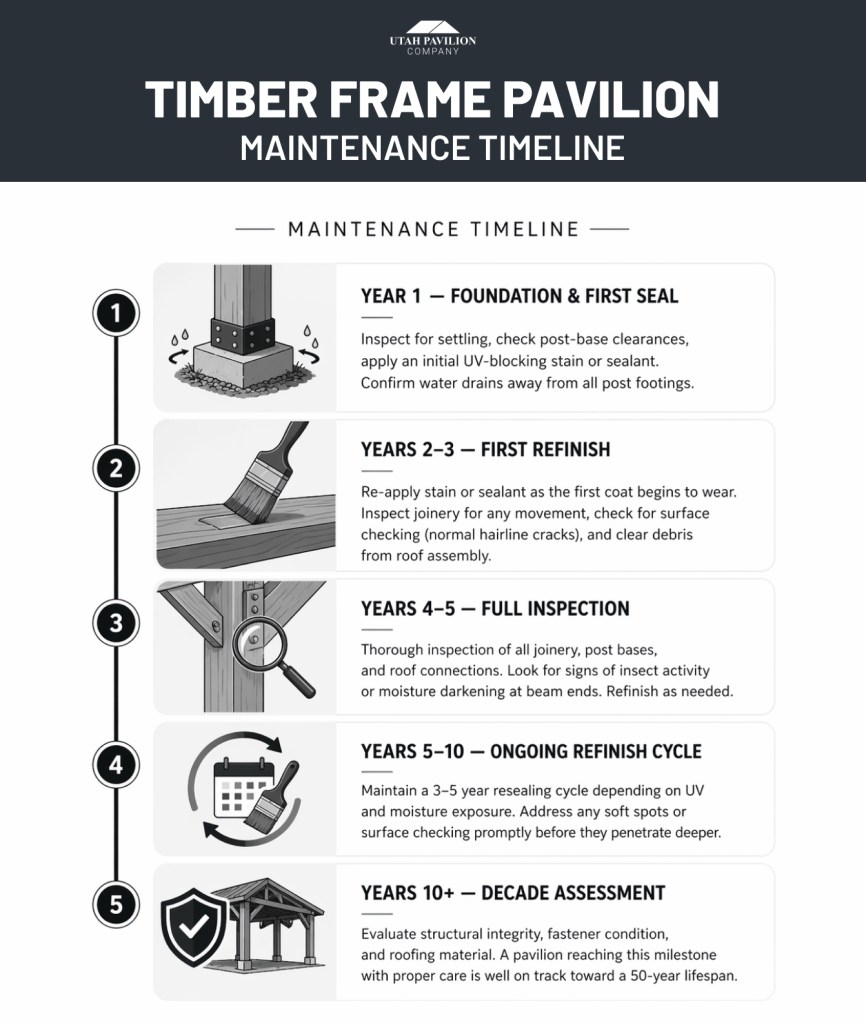
Therefore, the most cost-effective strategy is consistent annual inspection rather than waiting for visible failure. Catching soft spots or surface checking early prevents the scenario where a small repair becomes a replacement job.
How Utah Pavilion Company Builds for Longevity
Every decision Utah Pavilion Company makes in the build process traces directly back to a single question: will this structure still be standing in 40 years?
The answer starts with refusing to build with treated pine. Every pavilion uses select Douglas Fir or Cedar, premium species chosen specifically for their outdoor performance in Utah’s demanding climate. Neither is a shortcut material. Both are chosen because they perform.
The second commitment is mortise-and-tenon joinery throughout. No metal brackets connect the structural members of any Utah Pavilion Company-built structure. The joints are cut to precise tolerances so they lock tight and continue to hold as the wood dries and seasons over the first years. Additionally, all joinery is pre-cut and pre-drilled in a controlled environment, eliminating the field errors that come from on-site cutting under pressure.
Key longevity differentiators include:
- Premium Douglas Fir and Western Red Cedar — never treated pine
- Traditional mortise-and-tenon joinery at every structural connection
- Roof designs engineered for Utah snow load requirements
- Post base details that keep end grain elevated and dry
- Pre-stained and pre-drilled components on pavilion kits
- Clean job sites — protection of your property during installation
For homeowners outside Utah, the same craftsmanship ships nationwide as pre-cut, pre-labeled pavilion kits with complete installation guides. Furthermore, the same mortise-and-tenon standard applies to every kit — because longevity should not be a premium feature.
Utah Pavilion Company
Custom timber frame pavilions built with premium wood and traditional mortise-and-tenon joinery — designed to outlast the decade.Get Your Free Quote
Frequently Asked Questions About How Long a Timber Frame Pavilion Lasts
How long does a cedar pavilion last outdoors?
A Western Red Cedar pavilion typically lasts 30–50+ years outdoors with proper sealing and periodic re-staining every 3–5 years. Cedar’s natural oils provide built-in rot and insect resistance that extends its baseline durability without chemical treatment.
Does a timber pavilion need to be sealed every year?
Annual sealing is generally not required. A quality UV-blocking stain or sealant typically lasts 3–5 years under normal conditions. In high-UV locations or exposed south-facing orientations, a 2–3 year recoat cycle is recommended.
What shortens the life of a timber frame pavilion most quickly?
Moisture trapped at post bases is the leading cause of premature failure. End grain in direct contact with soil or pooling water deteriorates rapidly. Proper post footings, grading, and base clearances prevent the majority of serious structural decay issues.
Is Douglas Fir or Cedar better for a pavilion in Utah?
Both perform well in Utah. Cedar offers stronger natural rot resistance with lower maintenance demands. Douglas Fir provides superior structural strength for large-span designs. Utah Pavilion Company uses both — the right choice depends on your design and site conditions.
How does a timber frame pavilion compare in lifespan to a pergola?
A fully roofed timber frame pavilion generally outlasts an open pergola because the roof shields structural timbers from direct rain and UV exposure. However, both can achieve 25–50+ year lifespans when built with premium wood and mortise-and-tenon joinery. Explore the full comparison at our timber frame pavilion vs. pergola overview.
How Long Does a Timber Frame Pavilion Last? The Bottom Line
A timber frame pavilion lasts 25–50+ years when it is built from the right materials, joined with traditional methods, and maintained on a consistent schedule. That range is not theoretical — it is the direct result of decisions made at the design and construction stage, followed by reasonable care from the owner.
Wood species, joinery type, and climate response are the three factors that no amount of resealing can compensate for if they were wrong from the start. Select Douglas Fir or Western Red Cedar, paired with mortise-and-tenon joinery and a roof designed for your site’s actual snow load, gives your structure the foundation to reach the upper end of that lifespan range.
Additionally, Utah’s freeze-thaw cycles, UV intensity, and heavy snowfall make local expertise genuinely valuable — not just a marketing claim. A builder who understands how Utah’s climate stresses outdoor wood structures designs differently than one who follows generic specifications.
For homeowners ready to build something that lasts, browse Utah Pavilion Company’s full pavilion styles or visit the FAQ to explore common questions before your first conversation with the team.