Choosing between an octagon vs hexagon gazebo is one of the biggest design decisions when planning a custom timber gazebo. While both shapes provide durable shelter and classic outdoor appeal, they differ in how they fit your yard, support different activities, and influence the overall look of your outdoor space. If you’re building a gazebo for a backyard in Bountiful, Centerville, or elsewhere in Davis County, Utah, selecting the right footprint early helps ensure the structure matches both your available space and how you plan to use it. We build both octagon and hexagon gazebos in Douglas Fir or Cedar using traditional mortise-and-tenon joinery, so the decision ultimately comes down to choosing the shape that best suits your property and lifestyle.
Quick Answer: Choose an octagon gazebo if you want the most floor space for dining, entertaining, or larger seating arrangements. Choose a hexagon gazebo if you need a more compact design that fits smaller yards or creates a cozy gathering space. Since both use the same Douglas Fir or Cedar mortise-and-tenon construction, the best choice depends primarily on your available space and how you plan to use the gazebo.
Key Takeaways
- An octagon gazebo suits larger yards, dining, and entertaining with a wide, symmetrical footprint.
- A hexagon gazebo suits smaller yards, hot tubs, and cozy seating with a tighter footprint.
- Both shapes use the same Douglas Fir or Cedar, mortise-and-tenon frame, and no metal brackets.
- Roof framing gets more complex as the number of sides increases, so confirm ground snow load and roof pitch with your builder before finalizing size.
- A free, no-obligation quote is the fastest way to confirm cost and timeline for either shape.
Octagon vs Hexagon Gazebo at a Glance
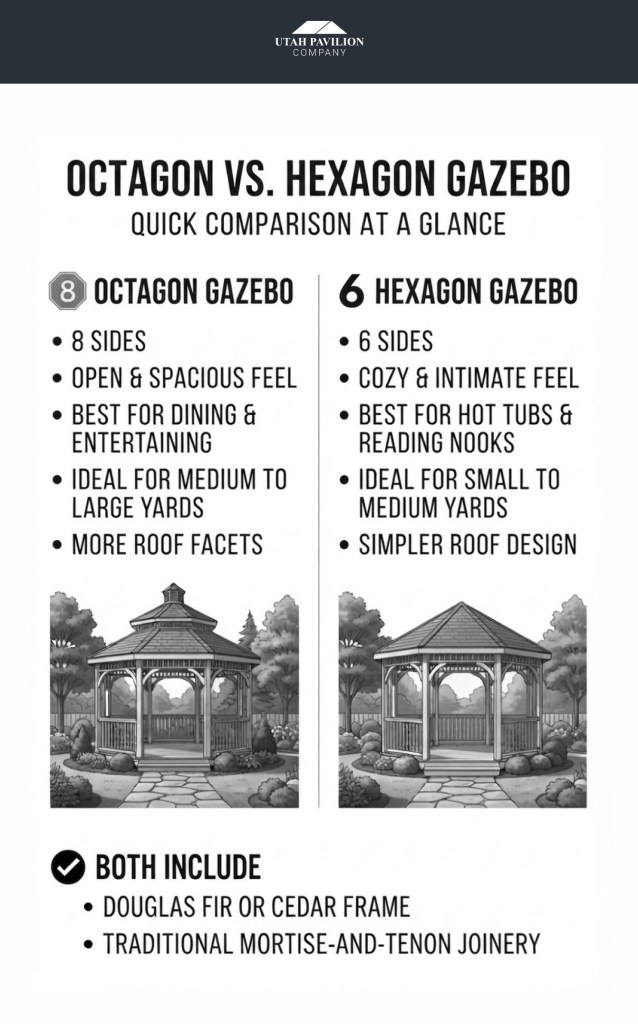
An octagon gazebo has eight equal sides and a wider, more symmetrical floor plan, while a hexagon gazebo has six sides and a smaller, cozier footprint that fits tighter yards. The table below lines up the two shapes side by side.
Sides, Footprint, Feel, and Best Use
| Feature | Octagon Gazebo | Hexagon Gazebo |
| Sides | 8 | 6 |
| Footprint feel | Open, symmetrical, panoramic | Compact, intimate, cozy |
| Typical best use | Dining sets, entertaining, open seating | Hot tubs, reading nooks, small-yard retreats |
| Roof style | Multi-hip roof with more facets | Multi-hip roof with fewer facets |
| Yard size fit | Medium to large yards | Small to medium yards |
| Frame material | Douglas Fir or Cedar, mortise-and-tenon | Douglas Fir or Cedar, mortise-and-tenon |
The Octagon Gazebo: Spacious and Symmetrical
An octagon gazebo gives you eight equal sides and a floor plan that reads as almost round, which is why it’s the shape most homeowners picture first when they think of a classic timber gazebo. The extra sides open up sightlines in every direction, so the structure works well in the middle of a yard rather than tucked against a fence line.
Why Eight Sides Create More Usable Floor Space
Compared with a similarly sized hexagon, an octagon gazebo generally provides a more open layout with smoother sightlines, making it easier to arrange larger dining sets or seating areas. The roof has more hip rafters converging at the peak, so it takes more precise joinery to build correctly. We cut every hip rafter by hand and join it with mortise-and-tenon connections, not metal brackets, so the frame stays tight through freeze-thaw cycles instead of relying on hardware that can rust or work loose.
The Hexagon Gazebo: Compact and Cozy
A hexagon gazebo has six sides and a smaller overall footprint than an octagon of comparable width, which makes it the better fit for a tighter side yard, a corner lot, or a spot next to a hot tub. The shape still delivers full shade and rain protection under a solid roof; it just does it in a smaller, more enclosed package.
Why Six Sides Fit a Smaller Yard
Fewer facets mean simpler roof framing and a footprint that feels enclosed and private rather than open. A hexagon gazebo works well with a ring of built-in benches, a small bistro table, or a hot tub at the center. It can also slide into a corner of the yard where an octagon’s wider profile wouldn’t fit. Like the octagon, we build the hexagon frame in Douglas Fir or Cedar with mortise-and-tenon joinery and no metal brackets, so the smaller footprint does not mean a lighter-duty structure.
Does Wood Species Change Between Shapes?
No. We build the frame in the same Douglas Fir or Cedar on both shapes, with the same mortise-and-tenon joinery and no metal brackets. Cedar’s natural oils give it resistance to rot and insects without chemical treatment, a property the Western Red Cedar Lumber Association documents as one of the species’ core advantages in exterior structures. That durability holds regardless of how many sides the roof has, so an octagon and a hexagon age the same way when built from the same species and finished the same way.
Which Shape Fits Your Yard and How You’ll Use It
The right shape comes down to two questions: how much yard you have to work with, and whether you’re building for entertaining or for a quiet retreat. Answer those two first and the shape usually decides itself.
Space, Seating, and Style Guidance
- Large backyard, want to entertain or seat a dining set: an octagon gazebo gives you the open floor plan for it.
- Small side yard, corner lot, or a spot beside a hot tub: a hexagon gazebo fits the tighter footprint.
- Want a reading nook or quiet retreat: the enclosed, cozy feel of a hexagon usually wins out.
- Planning a wedding, party venue, or frequent hosting: the wider sightlines of an octagon serve larger groups better.
- Not sure a gazebo is the right structure at all? Compare it against an open-roof pergola or a rectangular timber pavilion before you commit to a shape.
Home architecture is worth a look too, even though it’s a style preference rather than a structural one. An octagon’s wide, symmetrical roofline tends to read as classic and formal, which suits traditional or craftsman-style homes with matching rooflines. A hexagon’s tighter, steeper profile feels more contemporary and blends well with modern or compact-lot homes where a smaller accent structure makes more sense than a large centerpiece. Neither reading is a rule, but it’s a useful tiebreaker when the yard could fit either shape.

Does Roof Shape Affect Snow Load in Davis County?
Roof shape changes how a gazebo sheds snow and how complex the framing is, but it does not change the ground snow load your site has to design for. Ground snow load is set by your city and elevation under Utah’s adopted building code, not by whether the roof has six facets or eight.
An octagon roof has more hip rafters converging at the peak, which is a framing and labor consideration more than a strength difference. A hexagon roof, with fewer facets, is simpler to frame but still needs to be sized for the same local snow and wind conditions. Either way, roof pitch, footing depth, and post sizing should be confirmed against your specific address, not assumed from a table like this one.
Wind exposure works similarly to snow load: it’s a site factor, not a shape factor. An octagon’s extra facets can catch wind from more angles across an open backyard, while a hexagon’s tighter profile and often steeper pitch can shed wind-driven rain and snow more directly off fewer surfaces. Neither difference changes the ground snow load or wind rating your city requires, but it can influence which corner of the yard makes the most sense for placement. We factor orientation into the design step, alongside the same footing, post, and roof pitch questions we’d ask for either shape.
Roof Framing Comparison
| Consideration | Octagon Gazebo | Hexagon Gazebo |
| Roof facets | 8 hip sections converging at the peak | 6 hip sections converging at the peak |
| Framing complexity | More hip rafters, more joinery cuts | Fewer hip rafters, simpler framing |
| Snow shedding | Multiple facets shed snow in several directions | Fewer, often steeper facets shed snow in a tighter radius |
| Engineering input needed | Ground snow load, roof pitch, and footing size for your city | Same, confirmed for your specific site |
If you want to learn more about the engineering principles behind timber gazebo construction before your consultation, the Western Wood Products Association (WWPA) provides technical guidance on solid-sawn lumber framing and span design. For building code requirements, the International Code Council (ICC) publishes the International Building Code, which serves as the basis for structural design requirements adopted or adapted by many Utah jurisdictions. These resources provide helpful background information, but they should not replace a site-specific review by your builder and local building department.
Customizing Your Gazebo Shape
Both an octagon and a hexagon gazebo can be customized with the same finish options, from a cupola on top to built-in benches around the interior perimeter. The shape sets the footprint; the finish decisions are where the design becomes yours.

Benches, Cupola, Roofing, and Stain Options
We build every gazebo to order, so size, joinery, and finish are fully custom rather than picked off a fixed catalog. Common upgrades include a center cupola for extra height and light, built-in perimeter benches, and a stain that matches your deck or fence.
Common Mistakes When Choosing a Gazebo Shape
Sizing, Placement, and Permit Pitfalls to Avoid
The most common mistake is picking a shape on looks alone and skipping the clearance math. That leaves an octagon crowding a fence line or a hexagon feeling too tight for the furniture planned inside it. A second mistake is assuming a smaller hexagon avoids permit requirements. Permit triggers come from square footage, foundation type, and electrical work, not the number of sides, so it’s worth confirming whether you need a permit for a gazebo in Utah before ordering either shape. A third mistake is choosing a foundation after settling on a shape, rather than alongside it, since a permanent concrete footing must be sized and placed to match the final footprint. We walk through all three: shape, foundation, and permit requirements during the design step so nothing has to be redone later.
How We Build Your Octagon or Hexagon Gazebo
Building either shape follows the same three-step process, so the timeline and communication stay consistent no matter which one you choose. We start with design confirmation: we visit the property, talk through your shape, size, and stain preferences, and give a final estimate once the scope is set. From there, we order your timber frame gazebo and schedule the build, cutting and joining every hip rafter and post by hand with mortise-and-tenon connections. Once the frame is ready, we deliver it and handle on-site installation, and the space is yours.
The number of sides changes how much hand-joinery time goes into the roof, since an octagon has two more hip rafters converging at the peak than a hexagon does. That extra joinery is labor, not a shortcut, and it’s one reason we walk through timeline expectations during the design step rather than quoting a build time off a general table. We keep the same transparent pricing process and clean job sites on every gazebo, regardless of shape.
Custom-Built or Pre-Cut Kit: Which Fits Your Shape?
Both routes are available for homeowners weighing an octagon or hexagon gazebo, and the right one depends on whether you want us on site or you’re building it yourself. A professionally installed custom gazebo is fully designed around your yard, with our team handling every cut and joint from the mortise-and-tenon frame to the finish stain. A pre-cut kit ships nationwide, pre-labeled and pre-stained, with mortise-and-tenon connections and no metal brackets, so a capable DIYer, contractor, or landscaper can assemble it on site with the included layout diagrams.
Frequently Asked Questions
Is an octagon or hexagon gazebo cheaper?
Shape has less effect on price than size and material do. Published general market ranges for a gazebo run from a few hundred dollars for a small pop-up kit up to the higher end of custom timber pricing, with DIY kits generally landing between $1,500 and $5,000 and professional installation between $4,000 and $12,000 or more. These are general market ranges, not a Utah Pavilion Company price list, since we quote every project individually. See our gazebo cost guide for a fuller breakdown.
What size gazebo do I need for an octagon vs a hexagon?
An octagon generally needs a bit more yard width than a hexagon to feel proportional, since its wider floor plan is built for seating and dining.
Can a hexagon gazebo cover a hot tub?
Yes. A hexagon gazebo’s compact, enclosed footprint is a common fit for a hot tub pad, since it provides full roof coverage without the wider open profile of an octagon.
Do you build both shapes as custom timber structures in Utah?
Yes. We design, build, and install both octagon and hexagon gazebos across Utah, and we can talk through material, finish, and kit options for your specific site during a free quote.
Which shape looks more traditional?
The octagon is the silhouette most people picture as a classic gazebo, with its wide, symmetrical roofline. A hexagon reads as a bit more modern and compact, though both are built with the same post-and-beam frame and mortise-and-tenon joinery.
Can either shape be built to a custom size?
Yes. Size, stain, and joinery are fully custom on both the octagon and hexagon gazebo, so we design around your yard rather than fitting your yard to a fixed size.
Does the foundation differ between an octagon and a hexagon gazebo?
Foundation choice depends on size and permanence, not shape. A gravel or paver base works for smaller, non-permanent structures in either shape, while a permanent build needs concrete pier footings set below the frost line. Confirm footing type and depth with your builder for your specific site regardless of which shape you choose.
Does an octagon or hexagon gazebo take longer to build?
An octagon typically takes a bit longer due to its extra hip rafters and joinery cuts, though both shapes follow the same design-to-installation process.
Can I add electrical or lighting to either shape?
Yes. Electrical and lighting can be added to either shape, though wiring often affects permit requirements, so confirm this with your local building department during planning.
See Our Octagon vs Hexagon Gazebo Designs
Whether you’re leaning toward an octagon or hexagon gazebo, we don’t just ship kits; we build what we sell. Every gazebo we install features traditional mortise-and-tenon joinery with no metal brackets and is crafted from premium Douglas Fir or Cedar, never treated pine. Every gazebo is built to complement your property, withstand the elements, and provide a beautiful outdoor gathering space for years to come.
Browse our Project Gallery to compare completed octagon and hexagon gazebo designs and see how different layouts fit a variety of properties. You can also visit our FAQ page for answers to common questions about customization, materials, installation, permits, and maintenance, making it easier to plan your project with confidence.
Ready to choose between an octagon and hexagon gazebo? Contact us today for a free, no-obligation quote. We’ll help you compare your options, customize every detail to fit your property, and build a handcrafted timber gazebo that’s designed to provide lasting value and enjoyment for years to come.